Gazetteer · Didcot and Harwell
Web design in Didcot and Harwell
A fast-growing railway town beside two of the largest science and business parks in the south of England.
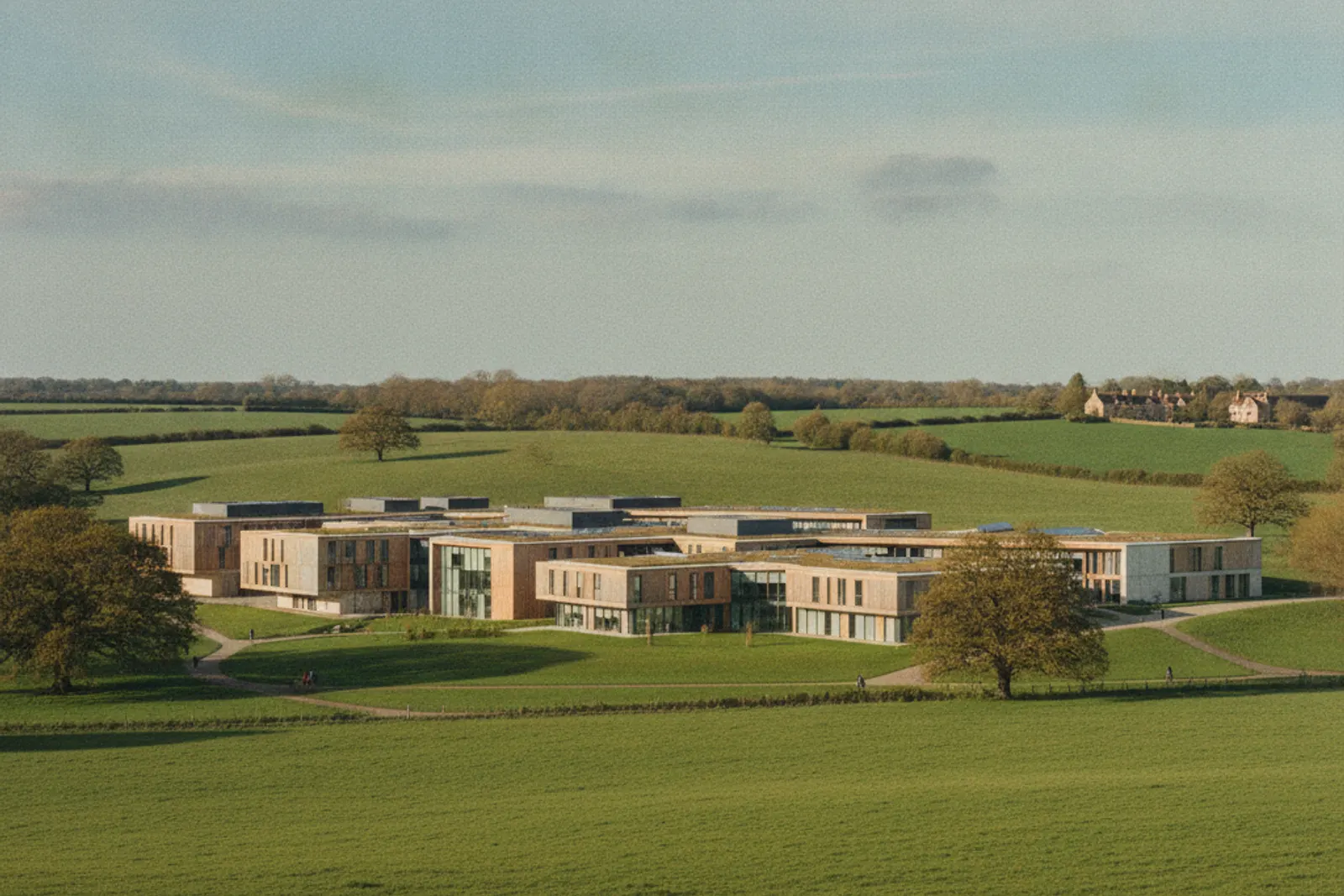
Didcot has changed more than almost any town in Oxfordshire over the past two decades. Large new neighbourhoods have grown up around it, Didcot Parkway station gives direct trains to London Paddington and the west, and two major employment sites sit on its doorstep.
The Harwell Science and Innovation Campus, about two miles outside the town, covers roughly 700 acres. Much of it was once the main research establishment of the UK Atomic Energy Authority; as the nuclear facilities were decommissioned it became a science and business campus. It is now home to national facilities including the Diamond Light Source synchrotron, and the STFC Rutherford Appleton Laboratory with the ISIS Neutron and Muon Source and the Central Laser Facility, alongside a growing community of companies in space, health technology, quantum and energy.
Milton Park, between Didcot and Abingdon, is home to more than 270 companies and over 9,000 people. Its occupiers include life sciences and biotech firms, some of them Oxford University spin-outs, as well as clean energy, battery technology, logistics and advanced manufacturing businesses.
Three audiences in one town
Websites in and around Didcot tend to serve one of three groups.
- Science and technology buyers, partners and funders, often national or international, who need precise, credible information.
- Specialist recruits, scientists and engineers deciding whether to relocate to south Oxfordshire.
- Local residents, many of them new to the area, looking for everyday services: childcare, fitness, trades, healthcare, food.
Each needs a different approach, and some businesses serve more than one.
Campus companies
Harwell and Milton Park companies range from two-person start-ups to large international firms. The smaller ones often have the same problem: excellent science, an impressive location and a website that does not explain either. Their audiences include government agencies, research councils, international partners and investors, all of whom will read the site critically.
We build these as websites for spin-outs and science companies, with layered technology pages, publication and news sections, team pages and careers. Where a company works with public bodies, accessibility to WCAG 2.2 AA is not optional: procurement teams increasingly check, and it is simply good practice.
Space and satellite firms at Harwell have a particular need to explain abstract products, such as data services, sensors or software, to non-specialist buyers. Diagrams, short worked examples of how a customer would use the product and plain-English summaries make a large difference.
Recruitment
Campus employers compete for scarce skills, and many candidates are weighing a move from elsewhere in the UK or abroad. A careers section that answers practical questions helps: what the work involves, what the team is like, how the campus works day to day, and how to get there. Didcot Parkway's rail links and the A34 are part of that story, and so is the honest reality of a rural campus.
Didcot's local economy
The growth of new estates has brought many new local businesses: nurseries, fitness studios, cafés, tutors, trades, pet services and clinics. Many opened recently and need a first proper website. The Orchard Centre in the town centre, the Broadway and the retail parks serve shoppers, while many service businesses work from home or small units.
For these, we build straightforward sites, usually on WordPress, focused on getting found locally and making it simple to book or enquire. New residents search for everything at once when they move in, typically "Didcot" plus a service, so clear service pages and a complete Google Business Profile do much of the work.
How campus buyers search
Technical buyers rarely search by location. They search for a capability, a technique or a named facility, and they arrive on a specific page, not the home page. That means every product, service or technology page must stand on its own: what it is, who it is for, the evidence, and how to start a conversation. Our guide on writing website copy for expert readers covers how to pitch these pages.
Getting around
We are happy to meet clients at the campuses or in town. Most projects run largely by video call and email, with an in-person workshop at the start where it helps. For campus companies, we can usually work around security and visitor arrangements with a little notice.
Useful services here
Websites for spin-outs and labs
Accessible websites
WordPress development